Meet Jan Martens, the choreographer of CANCEL BERTHA!
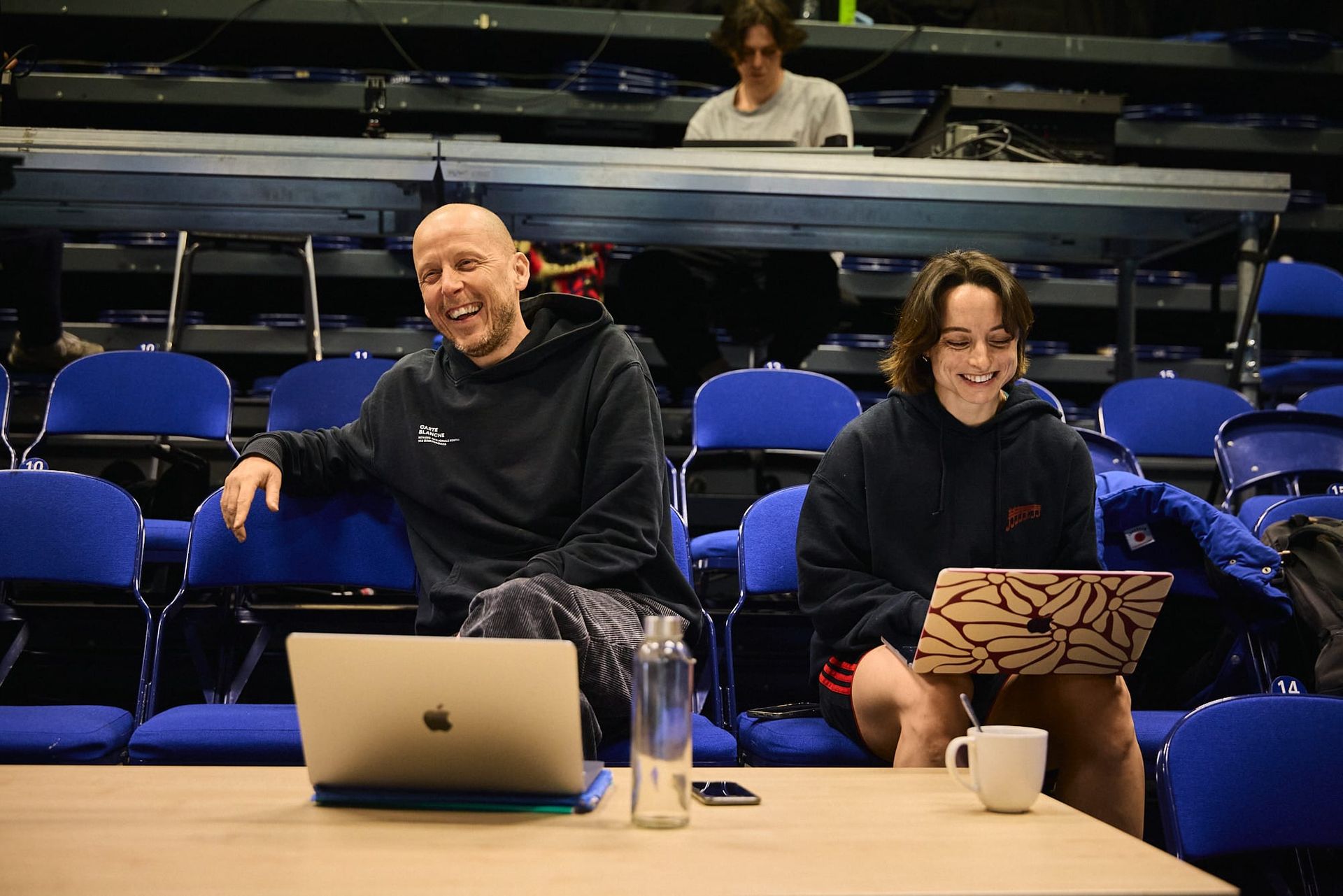
Choreographer Jan Martens and choreographic assistant Noami Gibson. Photo: Øystein Haara
Meet Jan Martens, the choreographer of CANCEL BERTHA!
Can you tell us a bit about your background, and what led you into choreography?
I grew up in a village in the north of Belgium and was lovingly raised, but without art. At sixteen, I was a closeted gay teenager who felt a lot of shame and had a difficult relationship with my body. But I remember being in my bedroom, falling into a kind of trance when moving weirdly to Kate Bush and Tori Amos in repetitive fashion. Dancing helped me to find comfort in my body, to enjoy my body, and to accept it.
Around the same time – because we had to for school – I saw my first contemporary dance and theater shows, including work by Jan Fabre and ROSAS (Anne Teresa De Keersmaeker’s company). I was struck by the perceived ease and comfort with which these performers inhabited their bodies. It made me want to achieve the same. After a failed year at university studying Dutch and English, I auditioned for a dance school in the Netherlands.
As a young man, it wasn’t that hard to get into the program, even though I had very little technical dance training. During these years, I saw a lot of shows that disappointed me, and I witnessed works by companies where I couldn’t imagine myself being happy. This fact, plus the need for self-expression, led me to create some short works as a dance student, around the age of 21. And since then, I never really stopped creating.
ANCEL BERTHA is an anagram of Carte Blanche. Is that just a playful twist, or does the title suggest something deeper about your approach here?
When I create work for an existing dance company, the identity of that company is always a starting point. I perceive Carte Blanche as a company in which each of the dancers has a strong identity, and a unique way of moving. The anagram idea came out of that line of thought. I wanted to reconfigure the dancers – or letters – of the company in a new constellation, hoping that this work would not only showcase all of their individual qualities but also their excellence in collaborating as a well-functioning mechanism, or universe.
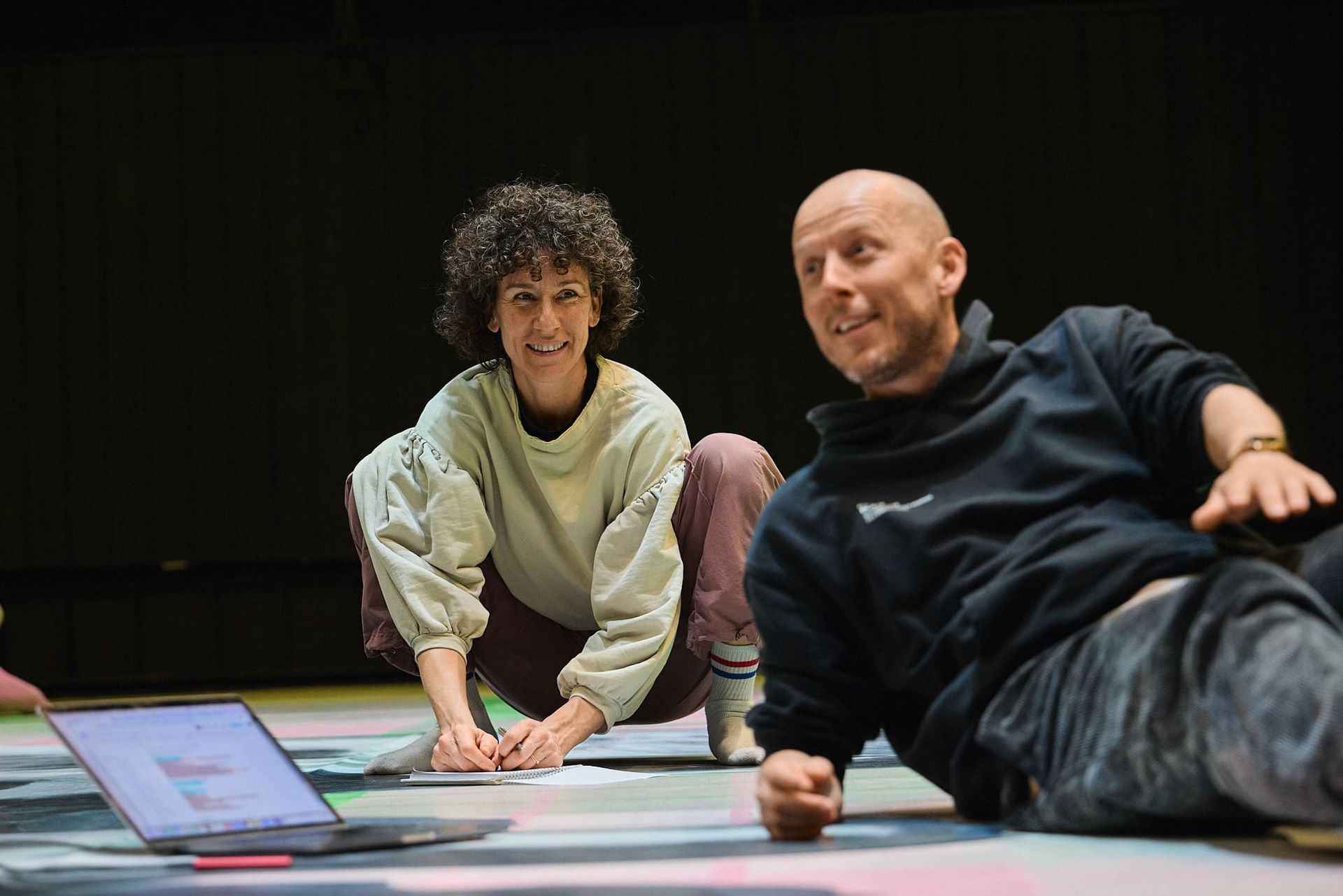
In the photot: rehearsal director Caroline Eckly and Jan Martens
In CANCEL BERTHA, music isn’t always something we hear–it’s something we see, feel, and sometimes imagine. How did you arrive at that concept, and what possibilities does it open up choreographically?
Even though I love choreographing to music, and the relation between dance and music is an important theme in my latest works, I often feel that music can be too present a driving force in dance. It can color so many feelings for an audience, or it can just serve as a safety net.
I wanted to challenge myself to create a work for 14 performers in which abstract dance is the main language, but in which music is not present in the same way. I wanted to find a way to the core of these dancers, and present their qualities in an unspectacular and stripped-down format.
There is a very interesting vulnerability which comes when dancing without music. You have nothing to rely on except your own mind and body, and the sounds the body can produce.
But I also didn’t want the work to become too conceptual. I love to see and bring dance to the forefront, and I love a good sweat. This led to the idea of using a lot of music during the process – to create dance phrases to it and then see what those phrases communicate once the music is taken away.
I hoped it would create a new, strange, absurd language, with an interesting and inherent but incomprehensible logic.
I have a lot of music in my playlist which I love dancing to, but which I consider bad taste, too emotional, too poppy, or just too short to bring into one of my dance works. You could say it’s a list of guilty pleasures. I never did get rid of all that shame.
So that is how we started this creation: me bringing in some music, and the dancers creating their own individual movements linked to certain parameters of the song. For example, translating the singing voice within the body, or embodying complicated staccato rhythms of an orchestral work by Górecki, or working around the drama contained in Lana Del Rey’s heartbroken words “I don’t wanna live” from her song The Dealer.
It was beautiful to see how 14 performers translate that song in 14 different ways.
But with no unison movement and no music present, the synchronizing of all those different danced phrases is an ambitious challenge that needs everyone’s full concentration and awareness to succeed, because you can’t fall back on the music. You need to understand everybody e
lse’s musicality and phrasing and find common ground to stay together as the mini society you’ve become.
There lies so much beauty in struggle and in almost succeeding.
The floor plays a central role in this piece. What drew you to that idea?
In a lot of dance, spacing is everything.
In the past, I have used simple geometric tape lines as scenography, in order for the dancers to position themselves precisely.
But this time, I wanted to create a contrast with the quite formal and abstract approach of the work. So I asked set designer Joris van Oosterwijk to design a floor that allows for spacing references for the dancers, but isn’t perceived as purely functional by the audience.
Inspired by the domestic tale of Sibylle Baier’s song Tonight, he proposed a 3D dog on a carpet. This ‘nest’ also becomes a kind of house for the dancers to inhabit and move through.
The floor was painted by hand in the scenic painting workshop at Den Nationale Scene (DNS), and they did an incredible job. We could have gone with a digitally printed floor using AI-generated imagery, but we wanted the way this floor was produced to echo the craft of the dance phrases that each performer created: the feeling that all of it is human-made.
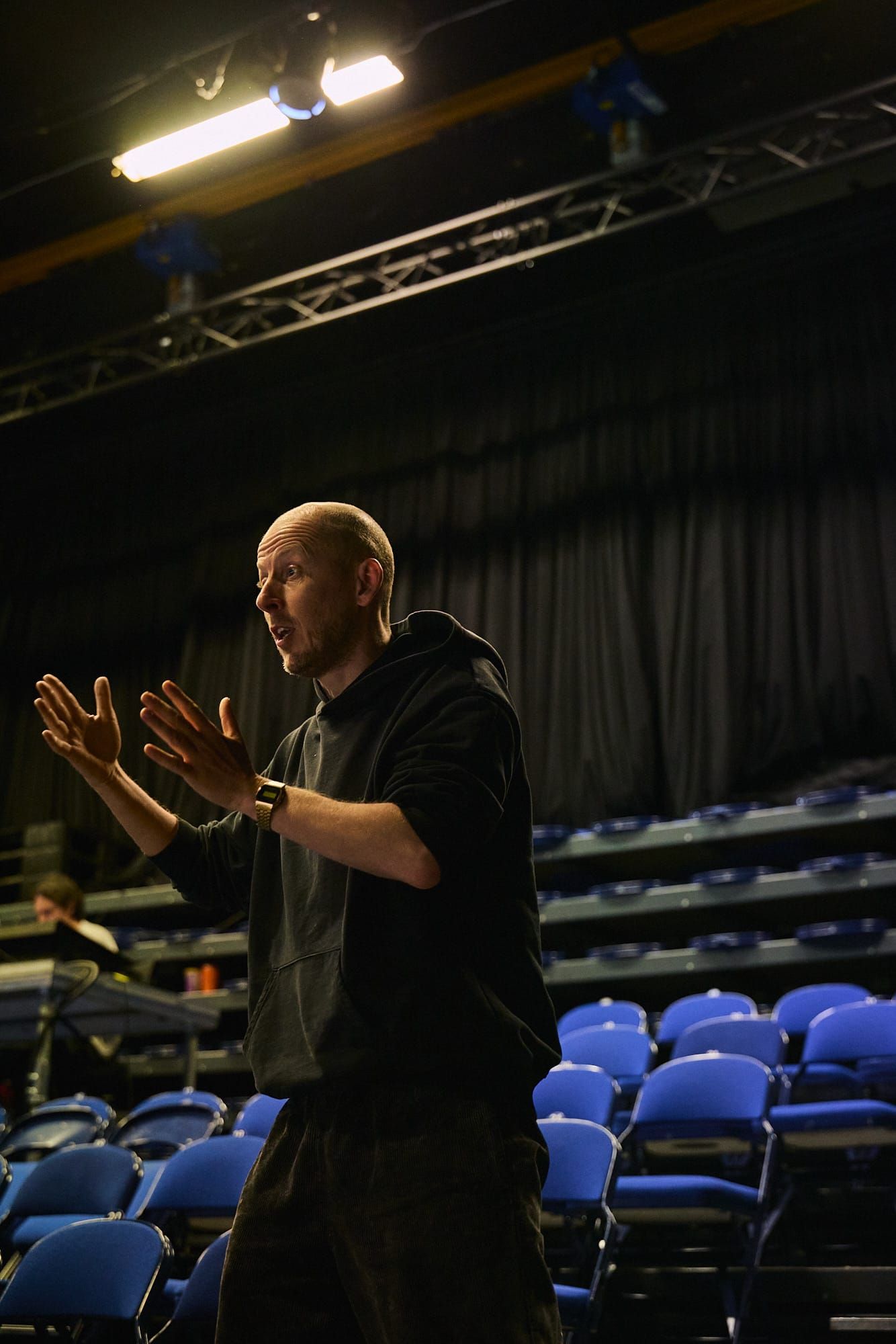
All photos: Øystein Haara
This is a work with moments of chaos, clarity, and humor. What questions were you asking yourself in the creation process – and have any of the answers surprised you?
As mentioned before, synchronizing different movements without musical accompaniment is extremely difficult. The dancers have to stay highly alert and keep an eye on everyone – even those on the periphery of the space – to stay together.
And so the main question for this creation is: can these challenges of close collaboration, and taking into account everyone’s unique vocabulary and musicality, become a metaphor for the investment needed when we truly and profoundly want to collaborate or cohabit in the same society?
Can a dance work built solely on abstract movement still carry that kind of societal undertone and meaning?
I asked myself the same question in a previous work, any attempt will end in crushed bodies and shattered bones. The big difference was that in that piece, the music took a leading role, which meant that it was much more obvious and easier for the performers to relate to the music than to each other. The music synchronized those different languages for them.
With this work, I wanted to take that same theme but put it into practice in the creation process. This means that we are taking a lot of time to tune in to each other, and spend a lot of time working in silence.
We work in great detail, which not only offers a deeper understanding of what you’ve created as a performer, but also of what your colleagues have created.
And one last question deals with perception. I’m quite intrigued by the idea of repetition, and how exact repetition is always perceived differently, because as a spectator you zoom in on a different body part, or the light is changing, or the constellation of the surrounding landscape on stage shifts.
So that question would be: How do we perceive the same movement material when we see it again and again, but in a different constellation, or with or without music, or with a slight variation in the quality?
I’m still in the midst of creation at the time of this interview, and I must say that answers always come to me late, even sometimes after the premiere. But I’m very happy with the current practice of deeper listening and watching, and eager to find out where this process is going to drive us.
When you start making a new piece, what usually comes first–the structure, the imagery, or the movement? And how does working with a new ensemble, like Carte Blanche, shift your process?
I feel like there is no recipe. Sometimes it’s the music, sometimes it’s a theme. Very rarely, it’s the structure or the movements. I always start a creation well prepared, but I also always remind myself that I should be able to change gears or direction at any given moment, just because each group brings a different reality – influenced by how that group feels each day.
In my work, there is always a coming together of strictness and freedom. It can take a while before performers I work with can start to play with the freedom, as the strictness can demand a lot of their concentration: the proposed structure, formality and cues often don’t allow for immediate play.
Sometimes, during a group talk after a run-through of a particular section, one of the performers would say:
“Hey, I think you want to achieve this, and you try to reach it by giving us this particular task – but wouldn’t it be easier if we just get into it like this?”
More often than not, they’re very right – and then I wonder why I spent an hour figuring out that complex transition. As one of the performers said: “I think all this mathematics can also be a trap.”
It is great because it forces you to be clear in your directing and in finding the right words. With a new ensemble, it often takes a bit of time before you understand each other’s language. This time, I felt I had the full backing of not only the dancers, but also the entire team and the wider Carte Blanche organization. That kind of focused investment from an entire organization on this one creation is a luxury you rarely find in Central Europe.
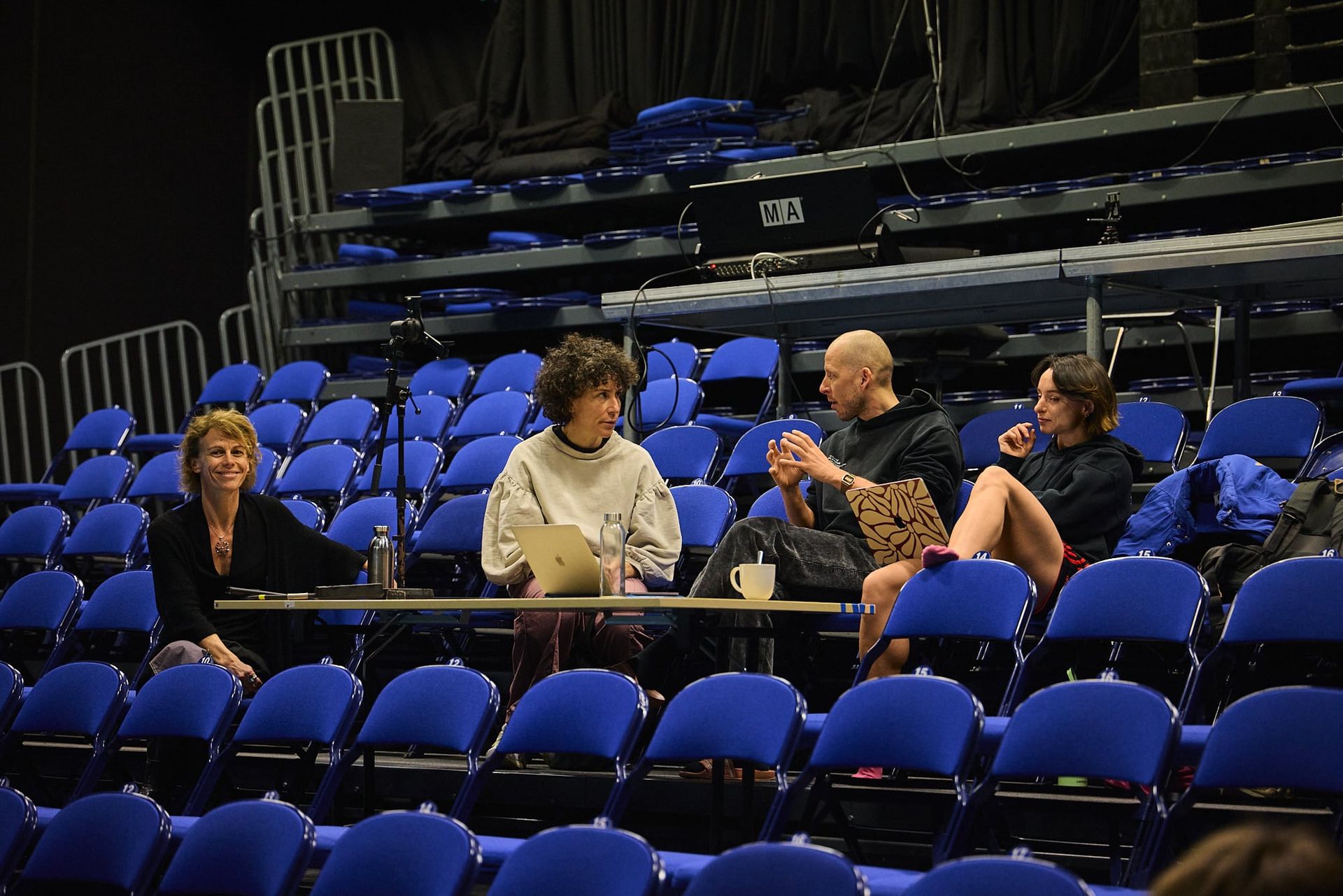
In Photo: Annabelle Bonnéry, Caroline Eckly, Jan Martens, Naomi Gibson
You have other works touring right now across Europe. Where do you see CANCEL BERTHA in relation to the rest of your artistic path?
I feel that making work for other companies isn’t always the right moment to take artistic risks. I am inclined to be more experimental working within my own company, but I do feel that CANCEL BERTHA is an exception to the rule.
I think it will take quite a singular position in my body of work. New commissions for other companies are on the way, but live music will feature in all of them.
With my latest creation VOICE NOISE, I opened the door to improvisation in my work, and in CANCEL BERTHA, I continue along that path.
With my own organization GRIP, we are bringing back my 2014 creation THE DOG DAYS ARE OVER, which is my only other work with very little music. In many ways, it feels as if CANCEL BERTHA is a more lyrical and poetic sister of THE DOG DAYS ARE OVER, as it shares its desire to let an audience come close to the performers and to let the performers stay close to themselves.
This human approach is something which unites all of my works and goes back to the time I was an audience member and not yet a professional in the performing arts field. Back then I loved the theater because it was one of the few places left where you can concentrate uninterrupted for an hour or more on one thing – where you can unashamedly watch and observe the people on stage, and by doing that learn more about yourself. That’s why I still love the theater today.