Get to know the choreographers behind Insight!
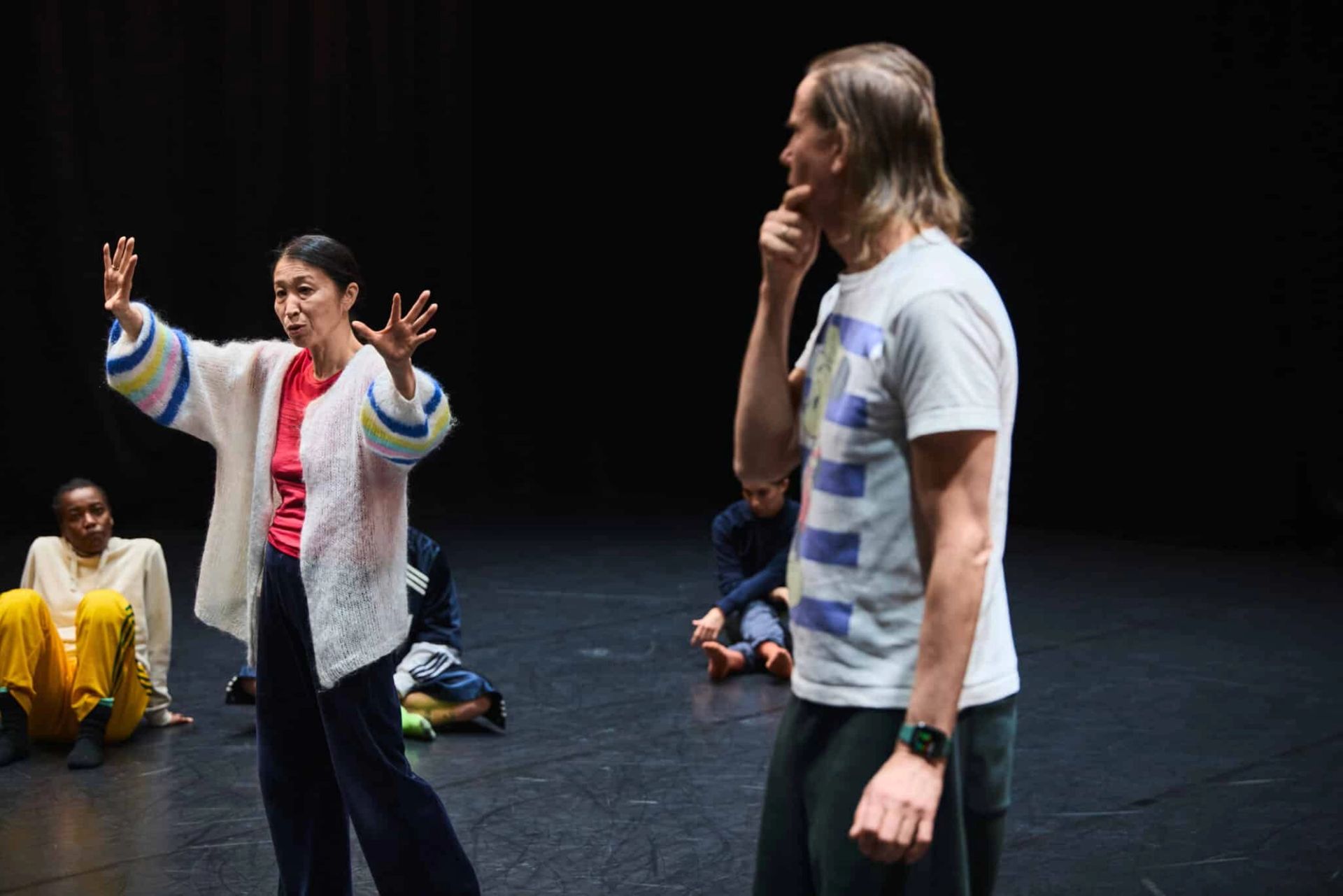
Photo: Øystein Haara
Get to know the choreographers behind Insight!
Heine Avdal and Yukiko Shinozaki are the choreographers behind Insight. In this interview, they share their backgrounds, their collaborative working process, and how the relationship between the individual and the collective is explored through movement, light, and sound.
Can you tell us a bit about your backgrounds, and how you first began working together?
Heine:
My background in dance began with ballroom dancing as a child, followed by breakdancing during my teenage years with friends in our group, Crazy Rockers. I later continued my education at KHIO in Oslo and at P.A.R.T.S. in Brussels. This mix of social, street-based, and formal training continues to shape how I approach movement, collaboration, and choreography today.
Yukiko:
I studied classical ballet in Tokyo from the age of six until I was eighteen. After graduating from high school, I decided to stop dancing and moved to the U.S. because I wanted to explore something different. I chose psychology as my major at Portland State University in Oregon. The university also had a dance department, and it was there that I discovered contemporary dance. In Japan, I had only danced ballet, so this was a real eye-opening experience for me.
After finishing my BA, I moved to New York to pursue a career as a dancer. I also began creating my own projects and presented work in venues such as Judson Church and St. Mark’s Church.
We first met during a workshop with Meg Stuart in Brussels in 1996. During that workshop we became a couple, and soon after Meg invited both of us to join her company, Damaged Goods, where we worked as dancers from 1997 to 2000.
You have collaborated closely for many years. How has working together over such a long time shaped the way you make work today?
Our first duet was shown at Dixon Place in New York in 1996, so we have been collaborating for thirty years. Alongside our artistic partnership, we also share the lifelong project of raising two children together — a son who is 23 and a daughter who is 17.
This long-term collaboration has allowed us to develop a shared artistic discourse over many years. As a result, we have learned how to communicate and negotiate within the creative process, often understanding each other without needing to explain everything in words.
Even when we don’t agree, we have built a strong and equal trust that enables us to face difficulties and differences openly. We know when to listen and when to speak up, especially when something in the work is not functioning.
We also recognise that each of us bring specific qualities to the collaboration, and that these differences actively support and strengthen the work. Despite our long history together, we still try to surprise each other and to push the work into new, unfamiliar territories. By continuing to insist on working together, the collaboration keeps evolving.
When you begin a new piece, what usually comes first for you – a physical practice, a situation, a question, or something else?
Each production has its own starting point. Sometimes we make work for a theatre space, and at other times we create site-specific projects.
We often begin with a few visual images or key words that inspire us. These ideas usually come from everyday life, and from there we start improvising in the space.
At other times, a strong idea emerges precisely from uncertainty – from not knowing. By entering spaces or situations through observation, awareness begins to sharpen. In these moments, ideas can arise simply by noticing small details that might otherwise be overlooked.
We try to discover the work through the process itself and often work very intuitively. Rather than making detailed plans, we allow the work to unfold together with our collaborators. There is also an element of chance – chance encounters and chance discoveries – and this sense of discovery is central to how we work.
Insight is a title that points toward attention and awareness. What drew you to this title, and how does it resonate with the work you are making here?
For us, insight is the ability to gain a deeper understanding by paying close attention – to ourselves, to others, and to what is unfolding around us. In the work, this is reflected in how the dancers listen, respond, and question through movement.
Much of your work explores the relationship between the individual and the group. How does this relationship take shape in Insight?
In Insight, the relationship between the individual and the group is not treated as a fixed structure, but as something that is continuously changing. The dancers never move in isolation; every action takes place in relation to other bodies, other rhythms, and the space they share.
What shapes this relationship is constant negotiation. Each situation has to be read and often re-read: when to take space, when to make room, when to support, and when to step back. At times, an individual movement becomes a shared lift. At other moments, it reveals distance, friction, or even the fact that we are in each other’s way.
The group in Insight is therefore fragile and always in motion. It forms, dissolves, and reforms through small adjustments rather than fixed roles or hierarchies. The individual does not disappear into the collective, but neither can they act without consequence. Responsibility is shared – not as a rule, but as a lived practice, through attention, listening, timing, and care.
This is a work created with a large ensemble. How has working with the dancers of Carte Blanche Company influenced the piece?
In Insight, the choreography grew out of a close collaboration with the dancers. The movement language developed in response to who they are – both individually and as a group – and could only have taken this shape with this particular ensemble.
At the start, we were a little nervous about working with such a large group. But collaborating with the dancers of Carte Blanche has been a very positive and energising experience. They are highly skilled, generous, and deeply engaged. Their curiosity and attentiveness actively drove the work forward.
It has been exciting to observe how they processed the tasks we proposed and how they brought their own perspectives into the material. Through dialogue, shared responsibility, and trust, we created this piece together.
Light and sound play an important role in Insight. How do these elements interact with movement and shape the overall experience of the piece?
Light and sound are not treated as supporting elements in Insight, but as active participants in the choreography. From the outset, we have worked with all elements – movement, light, sound, space, and the presence of the audience – within a non-hierarchical system, where any element can take a leading role at any given moment.
Together, they form a larger body in motion. The movement of light interacts with the movement of sound, with the movement of human bodies, with the architecture of the space, and with the perceptual movement of the audience itself.
This approach relates closely to our interest in expanded choreography. Rather than directing attention toward a single focal point, we distribute focus so that different senses begin to communicate with one another. There is no final position or stable balance in how these elements meet; instead, they continuously shift attention and meaning.
For us, experiencing a performance is about how perception opens up – how the senses adjust, respond, and compose relationships in real time. Through these ongoing adjustments, the work can be seen differently for each audience member.
When audiences encounter Insight, what kinds of experiences or reflections do you hope the work opens up?
We hope Insight invites the audience into a felt experience of togetherness – where small shifts matter, and where different senses communicate with one another and become visible through movement.